How much does it cost to rent a warehouse in the East Valley? For a 10,000 square foot bay, the answer is base rent plus NNN charges, power, and any yard, and each piece moves with the building. Here is how to build that budget for industrial real estate in Chandler, Gilbert, Tempe and Mesa.
By David Pierce, MHG Commercial
How Much Does It Cost to Rent a Warehouse in the East Valley?
Tenants often start with one question: how much does it cost to rent a warehouse? The answer is a stack of line items, not a single rate. Pricing in the Phoenix industrial market has four layers: base rent, NNN charges, power and water, and premiums for extras such as a yard. Rents are quoted building by building, so this post shows how the number is built instead of offering an average that would mislead.
How much to rent a warehouse per month for 10,000 square feet?
Start with the formula. Monthly base rent equals the annual rate per square foot, times 10,000 square feet, divided by 12. That formula answers how much to rent a warehouse per month once you hold a real quote. Confirm first whether the quote is annual or monthly, and NNN or gross, because a gross quote folds expenses into the rent. On a 10,000 square foot bay, a small change in the rate repeats across every square foot and every month of the lease term.
Then add the layers on top of base rent:
- NNN charges for property taxes, insurance and common area maintenance (CAM)
- Utilities, including power, water and sewer
- A yard premium, if you need outdoor space
- Move-in costs such as a deposit and any tenant improvements you pay for
Tenants who budget only base rent often understate the monthly total.
What is the average warehouse rental cost per square foot?
Averages blur very different buildings. The average warehouse rental cost per square foot you see online blends small flex units with large distribution boxes, new construction with older stock, and asking rates with signed ones. Treat an average as a rough starting point and build a comp set instead: spaces near 10,000 square feet, with similar clear height, dock doors and power. Rents inside that set run in tighter ranges than any market-wide number.
What Is the Average Warehouse Rent per Square Foot by Zip Code?
Zip code averages are thin data in industrial space. A single zip may hold only a handful of comparable buildings, so one new project can move the average. Pricing follows building features more than boundaries:
| What moves the rate | Why it matters | What to ask |
|---|---|---|
| Highway access | Loop 101, Loop 202, US-60 and I-10 shorten truck routes | Drive time to your main lanes |
| Airports nearby | Sky Harbor, Phoenix-Mesa Gateway and Chandler Municipal matter for air freight and parts | Distance to the airports you use |
| Building age and clear height | Newer, taller buildings often carry premiums | Clear height, dock count, column spacing |
| Submarket vacancy | Higher vacancy gives tenants more room to negotiate | How long the space has sat open |
When vacancy runs low, landlords tend to hold rents firm. When it rises, tenants gain leverage in leasing talks on free rent, improvement allowances and lease term.
What Is the Commercial Rent per Square Foot by City?
City names move rents and ranges less than building quality does. Tempe, AZ sits close to Sky Harbor and the I-10, US-60 and Loop 202 corridors. Chandler, AZ offers Loop 101 and Loop 202 access. Mesa, AZ spans wide ranges of building ages, including newer product near Phoenix-Mesa Gateway. Air-freight users should weigh all three airports. Gilbert, AZ and Queen Creek, AZ sit farther from Sky Harbor, so distance to your customers decides whether a lower rate actually saves money.
Commercial rent per square foot also covers office and retail, which follow different pricing logic. For warehouse space, compare only against other industrial buildings. National reports rank metros by one average rate, yet those metros each contain submarkets that behave differently, and Phoenix is no exception among large metros. Before you lean on how Phoenix compares with other metros, test the numbers against spaces you could actually lease.
How Much Does a Small Warehouse Cost?
The cost of a small warehouse is total occupancy cost, not the rate alone. Small spaces in multi-tenant parks can carry a higher rate per square foot than larger boxes, and they often share loading areas. If you need less than 10,000 square feet of warehouse space, ask landlords about divisible spaces. Then compare them with shared pallet storage and 3PL (third-party logistics) options that charge by pallet or by use. The trade is control and flexibility against a lower commitment.
How Much Does Power Add to a Warehouse Budget?
Power adds two kinds of cost: the monthly bill and the capacity of the building.
The bill comes from the electric provider, APS or SRP depending on the address, along with water, sewer and trash. Phoenix summers push cooling loads up, especially in an air-conditioned office. Ask the landlord for twelve months of utility bills from the prior tenant.
Capacity is the bigger risk. Check amperage, voltage and whether the building has three-phase power if you run conveyors, compressors or charging stations. If the service falls short, an upgrade needs utility engineering and can take months. Settle who pays before you sign, because a lease that starts before the power is ready means paying rent on warehouse space you cannot use.
How Much Does a Yard Add to Warehouse Rent?
A yard is fenced outdoor area for trailers, vehicles, equipment or outdoor storage. Yard square footage usually sits outside the 10,000 building square feet, so confirm what the quoted rate covers.
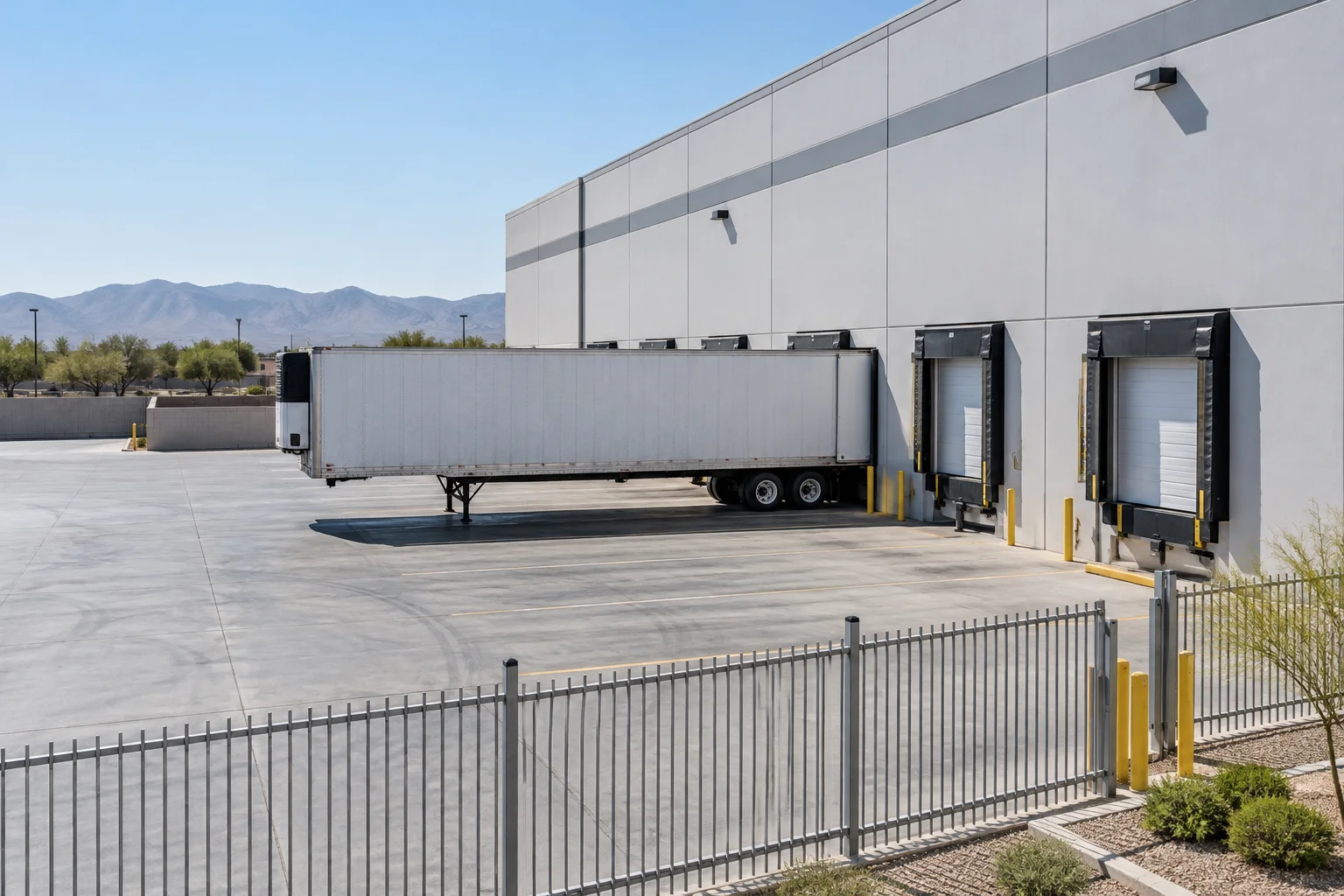
Yard pricing comes in three forms: folded into the building rate, charged as a separate line, or leased as ground. Premiums tend to follow surface, security, lighting and truck turning room. Three checks keep the number honest:
- Zoning: confirm the city allows outdoor storage for your use.
- Exclusivity: find out whether other tenants share the yard.
- Upkeep: paving, lighting and gate repairs often flow through common area charges.
Tours go faster with a list filtered to your truck count, power needs and yard use, and you can contact our brokerage to have one built around your operation.
What Does NNN Mean on a Warehouse Lease?
NNN means triple net. The tenant pays base rent plus a share of property taxes, insurance and common area maintenance, usually quoted per square foot per year. This is the hidden catch in many warehouse leases: two buildings with the same base rent can differ in monthly cost because their NNN charges differ.
Ask every landlord one question: how much does it cost to rent a warehouse like this one once NNN, power and the yard are included? Then ask for the prior year's actual NNN charges, whether CAM increases are capped, whether a management fee is included, and whether roof, structure or HVAC replacement can be passed through to tenants. Many warehouse leases give tenants audit rights, so check yours.
What other costs come with a warehouse lease besides base rent?
Beyond NNN and utilities, plan for these items:
- Security deposit and first month's rent at signing
- Tenant improvements not covered by the landlord, such as office buildout
- Racking, dock equipment and forklifts
- Fire sprinkler or code upgrades your inventory may require
- Insurance, signage and permits
Several of these can be negotiated. Landlords may offer free rent or an improvement allowance in exchange for a longer term, and a renewal or expansion option adds flexibility if your needs grow. Leasing terms differ across warehouse leases, so read yours with your broker or attorney before you commit.
Questions People Ask About East Valley Warehouse Rent
How much does it cost to rent a warehouse near me?
The cost depends on the building, the submarket and the lease structure, so no honest single figure exists. Request the quoted rate per square foot, the rate basis, the estimated NNN charges and the power setup for each building, then compare the totals.
How do you calculate warehouse rent?
Multiply the annual rate per square foot by the building's square feet, then divide by 12 for monthly base rent. Add the monthly share of NNN charges, power and any yard premium. Ask the landlord for last year's NNN actuals.
Is renting a warehouse expensive?
It depends on what you compare it to. A building with the right power, docks and highway access can cost more per square foot and still lower your total operating cost. Compare buildings on total occupancy cost, not rate alone.
Where can I find small warehouse space for rent in Phoenix, Arizona?
Start with small-bay and flex industrial space in Tempe, Chandler, Gilbert and Mesa, then widen the radius if inventory is tight. A leasing broker can often see listings that never reach public sites and can screen bays by power, dock access and zoning for your use.
Are co-warehousing and 3PL options cheaper than a lease?
Sometimes, at low volume. Co-warehousing and 3PL providers charge by pallet, by order or by use, so you pay for what you store and ship. A direct lease gives you control of the space, racking and hours, and your cost per square foot falls as you fill the building.
Get a Warehouse Budget Built Around Your Operation
Send your square footage, power needs and yard requirements, and the team at Pierce CRE will come back with a list of tours filtered to your operation.